
PRP hair treatment in Kalyan East uses a patient’s own blood platelets to stimulate hair follicles, with most people needing four to six sessions spaced three to four weeks apart before noticing visible regrowth. It’s most effective for early to moderate hair thinning rather than complete baldness, and results typically build gradually over three to six months. This guide covers how PRP works, what it costs, who it suits, and what the recovery and results timeline actually looks like.
PRP stands for Platelet-Rich Plasma — a concentrated part of your own blood that contains growth factors known to support tissue repair and cell growth. In hair treatment, PRP is injected into the scalp to stimulate weak or dormant hair follicles.
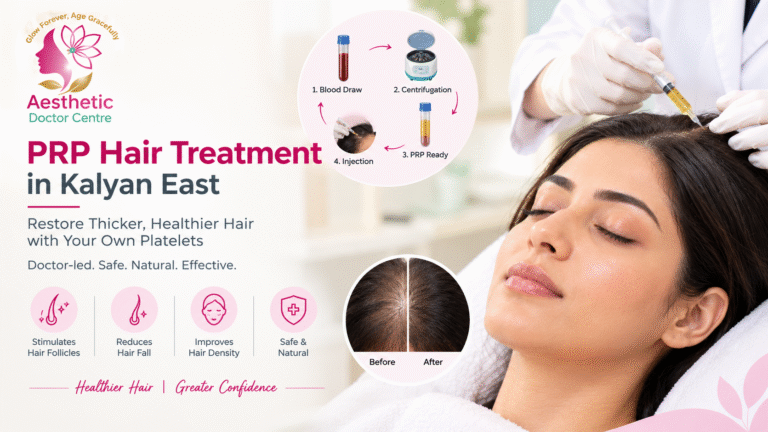
Platelet-rich plasma therapy works by drawing a small blood sample, processing it to concentrate the platelets, and injecting that plasma into areas of the scalp with thinning hair. The growth factors in the plasma are believed to improve blood supply to the hair follicle and extend the hair’s growth phase. Because the injection uses the patient’s own blood, the risk of allergic reaction is low.
A typical PRP hair treatment in Kalyan East follows the same core process across clinics, though exact protocols may vary slightly.
The full session usually takes 30 to 60 minutes, and most people can return to normal activities the same day.
PRP for hair loss in Kalyan East is generally recommended for people in the early to moderate stages of thinning, such as androgenetic alopecia (pattern hair loss) or diffuse thinning, rather than areas that are already completely bald. This is because PRP works by stimulating existing follicles — if a follicle has stopped functioning entirely, there’s nothing left for the treatment to activate.
PRP treatment for women’s hair loss in Kalyan is commonly used for conditions like female pattern hair loss and postpartum shedding, where thinning is spread across the scalp rather than concentrated in one bald patch. PRP treatment for baldness in Kalyan works best when there’s still some follicle activity present, which is why an early scalp assessment matters — the sooner thinning is addressed, the more follicles are typically still responsive to stimulation.
PRP and hair transplant address hair loss in fundamentally different ways: PRP stimulates existing, weakened follicles to grow stronger hair, while a hair transplant moves healthy follicles from one part of the scalp to a bald area. PRP is non-surgical and suited to early thinning, while a transplant is a surgical procedure typically considered for more advanced or localized baldness where follicles are no longer present.
Factor | PRP Treatment | Hair Transplant |
Best suited for | Early to moderate thinning | Advanced or localized baldness |
Procedure type | Non-surgical injections | Surgical follicle relocation |
Downtime | Minimal, same-day recovery | Several days to weeks |
Sessions needed | Multiple sessions over months | Usually a single procedure |
Can be combined? | Yes, often used to support transplant results | Can be paired with PRP for better outcomes |
Many clinics recommend PRP as either a standalone treatment for early thinning or a supportive treatment alongside a transplant, depending on the extent of hair loss.
Mesotherapy involves injecting a cocktail of vitamins, minerals, and sometimes medications into the scalp, while PRP uses only the patient’s own concentrated plasma. Both aim to improve scalp health and support hair growth, but PRP is generally considered to have a stronger evidence base for stimulating natural growth factors, whereas mesotherapy formulations can vary widely between clinics. Some clinics use both treatments together as part of a broader hair restoration plan.
PRP hair treatment cost in Kalyan depends on the number of sessions required, the area of the scalp being treated, and the specific PRP technology or kit used by the clinic. PRP hair treatment cost per session is usually a more useful figure to ask about than a flat “total cost,” since most patients need a series of sessions rather than a single visit. Ask your clinic for a written breakdown of per-session pricing and the total number of sessions expected for your specific case.
PRP hair treatment sessions needed in Kalyan typically range from four to six initial sessions spaced three to four weeks apart, followed by maintenance sessions every four to six months to sustain results. The exact number depends on the severity of thinning and how the scalp responds to the first few sessions, which is why dermatologists usually reassess progress partway through the initial course.
PRP treatment results timeline generally follows a gradual pattern: reduced hair shedding within the first six to eight weeks, followed by visible thickening and regrowth over three to six months as hair completes its natural growth cycle. Hair growth is a slow biological process, so PRP results build up progressively rather than appearing immediately after a session — patience and completing the full recommended course matters more than any single treatment.
PRP hair treatment side effects in Kalyan are generally mild and temporary, including scalp tenderness, mild swelling, or minor redness at injection sites for a day or two. Because PRP uses the patient’s own blood, the risk of allergic reaction is low compared to treatments using external substances. Rare side effects can include infection at the injection site if aftercare instructions aren’t followed properly.
PRP hair treatment before and after results in Kalyan usually show a gradual difference — less hair fall and finer new growth appearing by the third or fourth session, with fuller-looking hair density by the end of the initial treatment course. Results vary based on the extent of hair loss at the start, age, and how consistently sessions are completed, so photos from other patients should be treated as a general guide rather than a guaranteed outcome for every case.
When searching for the best PRP clinic in Kalyan or a PRP hair treatment clinic near you, check that the clinic uses a proper medical-grade centrifuge and processing kit, and that a qualified doctor performs the scalp assessment and injections rather than unsupervised staff. A good clinic will also set realistic expectations about timeline and won’t guarantee results, since hair growth response varies from person to person.
Preparing properly for a PRP session can improve comfort and support better absorption of the plasma into the scalp. Most clinics provide simple pre-treatment guidelines rather than an elaborate routine.
Your dermatologist will review your medical history beforehand to confirm you’re a suitable candidate and flag any medications or conditions that need adjusting first.
Aftercare plays a meaningful role in how well the scalp responds to treatment and how quickly any mild irritation settles down.
In the first 24 to 48 hours:
In the following week:
Most people return to their regular routine within a day or two, since PRP has minimal downtime compared to surgical options.
PRP is often used alongside other treatments rather than as a standalone solution, particularly for moderate hair thinning. It’s commonly combined with:
Combining treatments is a decision your dermatologist will make based on the cause and extent of your hair loss, since not every combination suits every patient. Using multiple treatments together isn’t automatically better — it depends on what’s actually driving the hair loss.
A few misconceptions come up often during consultations, and clearing them up helps set realistic expectations.
Myth: PRP gives instant results. PRP works gradually as hair follicles respond to growth factors over weeks and months — there’s no immediate change after a single session.
Myth: PRP works the same for everyone. Response to PRP varies based on age, the cause of hair loss, how advanced the thinning is, and general scalp health, so results differ from person to person.
Myth: PRP is a permanent, one-time fix. Hair loss is often an ongoing process, particularly with genetic pattern baldness, so most people need periodic maintenance sessions to sustain results over time.
Myth: PRP can regrow hair anywhere on the scalp. PRP stimulates follicles that are still present but weakened. It cannot regenerate a follicle that has completely stopped functioning or an area that’s been bald for a very long time.
How many PRP sessions will I need for visible results? Most people need four to six initial sessions spaced three to four weeks apart, followed by periodic maintenance sessions to sustain results. Your dermatologist will adjust this based on how your scalp responds.
Is PRP hair treatment painful? A numbing cream is usually applied before injections, so most patients feel only mild discomfort rather than significant pain. Mild scalp tenderness for a day or two afterward is normal.
Can PRP regrow hair in a completely bald area? PRP works by stimulating existing, weakened follicles, so it’s less effective in areas where follicles are no longer present. It’s generally more suitable for early to moderate thinning than complete baldness.
How long do PRP hair treatment results last? Results typically last several months to a year, after which maintenance sessions are usually recommended to sustain the improvement, since hair growth cycles continue and natural aging factors persist.
Is PRP better than mesotherapy for hair loss? Both can support hair health, but PRP uses the patient’s own concentrated plasma and is generally considered to have stronger evidence for stimulating growth factors, while mesotherapy formulations vary between clinics.
How much does PRP hair treatment cost in Kalyan? Cost depends on the number of sessions needed and the scalp area treated, so it’s best to ask for a per-session cost estimate after a scalp assessment rather than a generic price.
Can women get PRP hair treatment too? Yes, PRP is commonly used for female pattern hair loss and postpartum shedding, where thinning is spread across the scalp rather than isolated to one area.
Do I need to stop any medication before PRP treatment? Blood-thinning medication like aspirin may need to be paused briefly before treatment if your doctor advises it, since it can affect the blood draw and healing process. Always share your full medication list during consultation.
Can PRP be combined with minoxidil or a hair transplant? Yes, PRP is often combined with topical minoxidil or used alongside a hair transplant to support scalp health and improve overall results. Your dermatologist will recommend combinations based on your specific hair loss pattern.
This article is for general educational purposes and does not replace personalised medical advice. Please consult a qualified dermatologist to assess your suitability for PRP hair treatment before starting.
Considering PRP for your hair loss? Book a consultation with Dr. Jyoti Ghindani at Aesthetic Doctor Centre to find out if PRP hair treatment is the right option for you.
The American Academy of Dermatology’s guide to hair-loss diagnosis and treatment describes PRP as one option that may be considered for hair loss. A dermatologist can assess the cause of thinning and determine whether PRP or another treatment is appropriate.




Acne scars Acne scar treatment Acne treatment Advanced skin treatment specialist Aesthetic clinic Aesthetic Dermatologist Aesthetic Doctor Centre Aesthetic Medicine Aesthetic physician Botox treatment Chemical peel clinic Chemical peel cost Chemical peels Chemical peels for pigmentation Chemical peel treatment Cosmetic Clinic Cosmetic dermatology Cosmetic dermatology expert Cosmetic procedures Cosmetic skin specialist Dermal fillers Dr Jyoti Ghindani Fine Lines Treatment General dermatology Glycolic peel Hair fall treatment Hair loss treatment Hair regrowth treatment Hair Thinning Hair thinning treatment Hydrafacial treatment Laser skin rejuvenation Laser skin resurfacing Laser skin treatment Laser Toning Melasma treatment Pigmentation treatment PRP hair treatment Salicylic acid peel Skin Care Tips Skin Consultation Skin rejuvenation Skin rejuvenation clinic Skin rejuvenation treatment Skin resurfacing
Book your Appointment