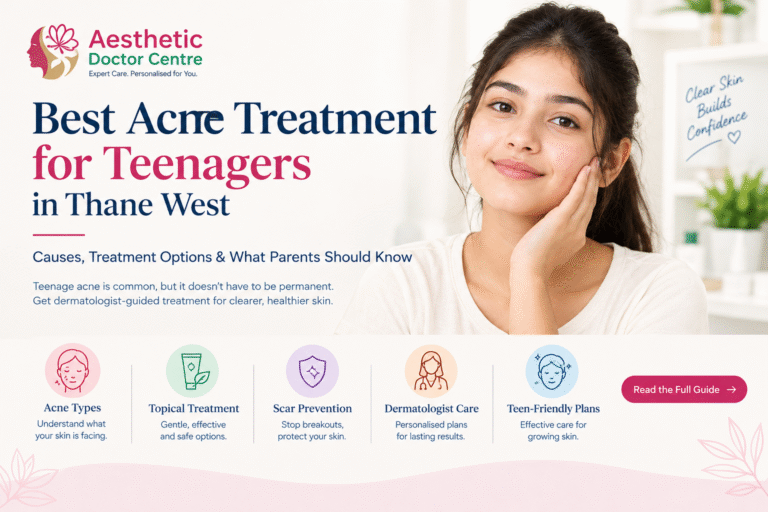
The best acne treatment for teenagers in Thane West starts with identifying the type of acne, whether it’s oily-skin breakouts, hormonal acne, or cystic acne, since teenage skin responds differently to treatment than adult skin and usually needs a gentler, more gradual approach. Most teenagers see improvement within six to eight weeks of consistent treatment, though persistent or cystic acne may need a longer, more structured plan. This guide covers the causes of teenage acne, the treatment options available at an acne clinic in Thane West, and what parents and teens should realistically expect from treatment.
Teenage acne is primarily driven by hormonal changes during puberty, which increase oil (sebum) production and make hair follicles more likely to become clogged. This is different from adult acne, which is more often linked to ongoing hormonal fluctuations, stress, or skincare habits developed over years.
Teenage skin tends to be more reactive to aggressive treatment, so dermatologists typically start with gentler options and escalate only if needed, rather than immediately jumping to stronger treatments used for adult acne. This cautious approach helps avoid excessive dryness, irritation, or peeling, which can discourage teens from sticking with their treatment plan.
Understanding which type of acne your teenager has matters, since blackheads, cystic acne, and hormonal breakouts don’t all respond to the same treatment.
Cystic acne, in particular, tends to cause more scarring than other types, which is why early treatment matters more for this form than for milder comedonal acne.
An acne clinic in Thane West typically follows a step-by-step approach, starting with the least aggressive option that’s likely to be effective and increasing intensity only if the initial treatment doesn’t produce enough improvement.
For mild to moderate teenage acne, dermatologists usually start with topical treatments like benzoyl peroxide, topical retinoids, or topical antibiotics, often combined with dermatologist-recommended skincare suited to oily or acne-prone skin. These are typically the first line of treatment because they’re effective for comedonal and mild inflammatory acne with a lower risk of side effects than oral medication.
A salicylic acid peel is commonly used for oily skin treatment and comedonal acne because salicylic acid is oil-soluble, meaning it can penetrate clogged pores more effectively than water-based ingredients. Peels are usually done in a series of sessions, spaced a few weeks apart, and are generally well tolerated by teenage skin when performed at an appropriate strength.
Hormonal acne treatment in Thane West for teenagers, particularly for breakouts concentrated around the jawline and chin, may involve specific topical treatments or, in some cases, medical evaluation of hormonal factors if breakouts are severe or resistant to standard treatment. This is typically considered after initial topical treatment hasn’t produced sufficient improvement.
For moderate to severe acne that hasn’t responded to topical treatment, dermatologists may consider oral antibiotics or, in more severe or persistent cystic acne cases, isotretinoin treatment. Isotretinoin is a potent oral medication reserved for severe, scarring, or treatment-resistant acne, and it requires close medical supervision due to its potential side effects and specific monitoring requirements. This is not a first-line treatment and is only considered after other options have been tried or in cases of significant scarring risk.
Pimple treatment in Thane West for occasional, isolated breakouts is usually much simpler than treatment for widespread or cystic acne. Spot treatments containing benzoyl peroxide or salicylic acid can help reduce a single pimple’s size and redness within a few days, though picking or squeezing pimples should be avoided since it increases the risk of scarring and spreading bacteria to surrounding skin.
Acne scar removal in Thane West becomes relevant once active breakouts are under control, since treating scars while acne is still active isn’t usually recommended. Options depend on the type of scarring:
Scar Type | Common Approach | Typical Downtime |
Shallow, rolling scars | Microneedling, chemical peels | 1–3 days |
Deep, ice-pick scars | Fractional laser, subcision | 3–7 days |
Dark marks (post-inflammatory) | Chemical peels, topical brightening | Minimal |
For teenagers specifically, dermatologists often wait until acne is more stable before starting scar treatment, since new breakouts can continue to form new scars during active treatment.
Parents often underestimate how much teenage acne can affect self-esteem, and early, appropriate treatment can help prevent both physical scarring and the emotional impact of persistent breakouts. It’s worth involving your teenager in the decision-making process, since consistency with a treatment routine, especially topical treatments used daily, significantly affects how well the plan works.
It’s also worth setting realistic expectations together. Acne treatment for teenagers typically takes six to eight weeks to show initial improvement, and consistent use, not switching products or treatments too quickly, tends to produce better long-term results.
Most teenagers see initial improvement within six to eight weeks of starting a consistent treatment plan, though moderate-to-severe acne can take three to six months for more complete results. Cystic acne and hormonal acne generally take longer to fully resolve than comedonal acne, since the underlying triggers are harder to control quickly. Sticking with the recommended routine, even when improvement feels slow, is usually more effective than frequently switching products.
Side effects vary depending on the treatment. Topical treatments can cause temporary dryness, redness, or peeling, especially in the first few weeks of use, which often settles as the skin adjusts. Oral medications carry their own specific risk profiles that should be discussed individually with the prescribing dermatologist. Isotretinoin, in particular, requires close monitoring due to more significant potential side effects, and should only be used under specialist supervision with appropriate follow-up.
Gentle, consistent skincare, cleansing, non-comedogenic moisturizer, and daily sunscreen, supports any acne treatment plan and can help with very mild breakouts on its own. However, for moderate, cystic, or hormonal acne, clinical treatment from a dermatologist generally produces faster, more predictable results and reduces the risk of scarring compared to relying on natural remedies alone. Many dermatologists recommend combining both: a solid daily skincare routine alongside any prescribed clinical treatment.
When choosing an acne clinic in Thane West for a teenager, look for a dermatologist who takes time to explain the treatment plan in terms both the teen and parent understand, rather than rushing through a generic protocol. A good clinic will also set realistic expectations about timelines and won’t promise instant or guaranteed results, since individual response to acne treatment varies.
At what age should a teenager see a dermatologist for acne? There’s no fixed age, but it’s reasonable to consult a dermatologist once acne starts affecting confidence, becomes persistent, or shows signs of scarring risk, such as cystic breakouts. Early evaluation can help prevent more significant scarring later.
Is over-the-counter treatment enough for teenage acne? Over-the-counter treatments containing benzoyl peroxide or salicylic acid can help with mild, comedonal acne, but moderate to severe or cystic acne typically needs a dermatologist’s involvement for faster, more effective results.
Can teenage acne go away on its own without treatment? Mild acne sometimes improves as hormonal fluctuations settle, but moderate to severe acne often persists or worsens without treatment, increasing the risk of scarring. Early, appropriate treatment generally leads to better outcomes than waiting it out.
Is isotretinoin treatment safe for teenagers? Isotretinoin can be prescribed for teenagers with severe, scarring, or treatment-resistant acne, but it requires close medical supervision and monitoring due to its potential side effects. It’s only considered after other treatments haven’t worked.
Will acne scars from teenage years fade on their own? Some superficial marks fade naturally over time, but deeper or textured scarring typically doesn’t resolve without treatment. Options like microneedling or laser treatment are usually considered once active acne is under control.
How can parents support a teenager going through acne treatment? Encouraging consistency with the prescribed routine, avoiding pressure to see instant results, and addressing any emotional impact openly can make a meaningful difference in how well a teenager sticks with treatment.
Does diet affect teenage acne? Some evidence links high-glycemic diets and dairy consumption to acne flare-ups in certain individuals, though the relationship varies from person to person. Diet adjustments are generally considered supportive rather than a standalone treatment for moderate-to-severe acne.
For more guidance on managing teenage acne, the American Academy of Dermatology (AAD) provides information about acne causes, treatment options, and daily skincare. Parents and teenagers can use these resources to understand common acne treatments and discuss suitable options with a qualified dermatologist. Early assessment can help manage breakouts and reduce the risk of acne scarring.
Book your Appointment