
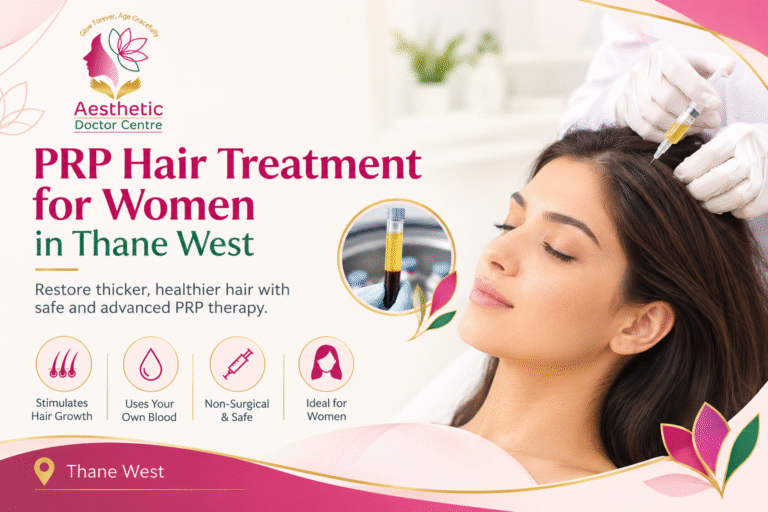
PRP hair treatment for women in Thane West uses platelet-rich plasma from a woman’s own blood to stimulate thinning hair follicles, and it’s most commonly used for female pattern hair loss, postpartum shedding, and diffuse thinning rather than androgenetic alopecia patterns seen in men. Most women need four to six initial sessions before seeing visible improvement in hair density, with results building gradually over three to six months. This guide covers how PRP hair treatment works specifically for women, what causes female hair thinning, realistic costs and timelines, and how it compares to other hair regrowth therapy options available in Thane West.
receding hairline or crown balding pattern commonly seen in men with androgenetic alopecia. This difference matters because it affects both diagnosis and treatment planning, since a woman’s thinning hair is often driven by a combination of hormonal, nutritional, and stress-related factors rather than genetics alone.
Women experience hair thinning through several distinct mechanisms, hormonal shifts, postpartum changes, thyroid imbalance, iron deficiency, and chronic stress, which is why an accurate diagnosis matters more than jumping straight into a specific treatment. A hair specialist typically reviews medical history, examines the scalp, and may recommend blood tests to identify underlying nutritional or hormonal causes before recommending PRP for hair loss in Thane West or any other treatment approach.
PRP stands for platelet-rich plasma, a concentrated portion of a person’s own blood that contains growth factors known to support tissue repair and cellular regeneration. In hair regrowth therapy, this concentrated plasma is injected directly into areas of the scalp experiencing thinning, with the goal of stimulating weakened or dormant hair follicles back into an active growth phase.
Because PRP uses a woman’s own blood, drawn, processed, and reinjected in the same visit, the risk of allergic reaction or rejection is low compared to treatments using external or synthetic substances. This is one reason platelet-rich plasma therapy has become a widely used non-surgical hair restoration option for women specifically.
A typical session takes between 30 and 60 minutes, and most women return to their normal daily activities the same day, since PRP involves minimal downtime compared to surgical hair restoration options.
PRP is generally most effective for women with early to moderate thinning where hair follicles are weakened but still present and capable of responding to stimulation. It tends to be less effective in areas of long-standing, complete hair loss, since PRP works by reactivating existing follicles rather than creating new ones.
PRP for hair loss in Thane West has become a popular non-surgical hair restoration choice among women specifically because it avoids the hormonal medications sometimes used for male pattern hair loss, which aren’t always suitable or preferred for women. Since PRP uses the patient’s own blood rather than external hormones or synthetic drugs, many women find it a more comfortable first step compared to oral medication.
PRP hair treatment for women works by delivering concentrated growth factors directly to areas of the scalp with thinning hair, which is believed to improve blood supply to the follicle and extend the hair’s natural growth phase. This mechanism makes PRP particularly suited to diffuse thinning patterns common in women, where the goal is strengthening existing hair across a broad area rather than targeting one specific bald patch.
Scalp micro-needling is frequently combined with PRP hair treatment, since the micro-injuries created by the needling process can enhance absorption of the plasma into the scalp and may further stimulate the body’s natural healing and collagen response. This combination approach is commonly used at clinics offering hair regrowth therapy in Thane West, particularly for women with more resistant or gradual thinning patterns.
Micro-needling alone can also be used as a standalone treatment for mild thinning, though many practitioners consider the combination with PRP to offer a more comprehensive stimulation of the scalp compared to either treatment used independently.
Growth factor therapy is the broader category PRP falls under, referring to treatments that use concentrated biological growth factors to stimulate tissue repair and regeneration. In the context of PRP hair treatment, the growth factors present in platelets, including platelet-derived growth factor and vascular endothelial growth factor, are believed to play a role in improving blood flow to hair follicles and supporting the hair growth cycle.
Understanding this mechanism helps set realistic expectations: PRP doesn’t introduce anything foreign into the body, it simply concentrates and redirects the body’s own healing resources to the scalp, which is why results tend to be gradual rather than immediate.
PRP hair treatment cost in Thane depends on several factors, including the number of sessions recommended, the areas of the scalp being treated, and the specific PRP processing kit or technology used by the clinic. Since most women need a series of sessions rather than a single visit, it’s more useful to ask for a per-session cost estimate and the total expected number of sessions, rather than relying on a generic “starting from” price often advertised online.
A written treatment plan with transparent, itemized costs allows for better comparison between clinics offering PRP clinic services in Thane West, and it also helps avoid unexpected costs partway through a treatment course.
Most women need four to six initial PRP sessions, spaced three to four weeks apart, before noticing meaningful hair density improvement, followed by maintenance sessions every four to six months to sustain results. The exact number of sessions depends on the severity and underlying cause of thinning, which is why many hair specialists reassess progress partway through the initial treatment course and adjust the plan if needed.
Women treating postpartum shedding sometimes need fewer maintenance sessions once hormone levels stabilize naturally, while those with an ongoing hormonal or genetic predisposition to thinning typically need a longer-term maintenance schedule.
Results from PRP hair treatment typically follow a gradual pattern: reduced hair shedding within the first six to eight weeks, followed by visible improvement in hair density and thickness over three to six months as the natural hair growth cycle progresses. Hair growth is a slow biological process regardless of the treatment used, so PRP results build up progressively across the full treatment course rather than appearing after a single session, and patience with the recommended schedule tends to produce better outcomes than expecting immediate change.
Women often notice reduced hair fall in the shower or on their pillow before they notice actual visible thickening, which is a useful early sign that the treatment is working even before density improvements become visually obvious.
PRP hair treatment side effects are generally mild and temporary, including scalp tenderness, minor swelling, or slight redness at injection sites for a day or two following the session. Because PRP is derived from the patient’s own blood, the risk of allergic reaction is notably lower than with treatments using synthetic or donor-derived substances. Rare side effects can include minor bruising or, if aftercare isn’t followed properly, a small risk of infection at injection sites.
Women who are pregnant, breastfeeding, or have certain blood disorders should discuss their eligibility for PRP with a qualified hair specialist before proceeding, since these factors can affect suitability.
Non-surgical hair restoration for women includes several approaches beyond PRP, and understanding how they compare can help clarify which option, or combination, fits your specific situation.
Treatment | How It Works | Best Suited For | Downtime |
PRP hair treatment | Injects concentrated growth factors from own blood | Early to moderate diffuse thinning | Minimal |
Scalp micro-needling | Creates micro-injuries to stimulate healing response | Mild thinning, enhances PRP absorption | Minimal |
Topical minoxidil | Applied directly to scalp to support hair growth cycle | Ongoing maintenance, mild to moderate thinning | None |
Mesotherapy | Injects vitamins and nutrients into the scalp | General scalp health support | Minimal |
Low-level laser therapy | Uses light energy to stimulate follicles | Mild thinning, at-home maintenance | None |
Many hair specialists recommend combining PRP with topical minoxidil or scalp micro-needling for a more comprehensive approach, since each addresses hair regrowth through a slightly different mechanism.
A first visit to a PRP clinic in Thane West typically includes a scalp examination, a review of your hair loss history and any previous treatments tried, and often a discussion about diet, stress levels, and any relevant hormonal history, such as recent pregnancy or thyroid conditions. This thorough evaluation matters because treating female hair loss without identifying the underlying cause often leads to limited or temporary improvement.
When choosing a PRP clinic in Thane West, confirm that the clinic uses a proper medical-grade centrifuge and processing kit specifically designed for PRP preparation, and that a qualified doctor, not unsupervised support staff, performs the scalp assessment and injections. According to guidelines from the Indian Association of Dermatologists, Venereologists and Leprologists (IADVL), procedures involving injectable treatments should be performed or directly supervised by appropriately trained medical professionals.
A few misconceptions come up repeatedly during consultations, and clearing them up helps set realistic expectations before starting treatment.
Myth: PRP works the same way for every woman. Response to PRP varies based on the underlying cause of thinning, age, hormonal status, and general scalp health, so two women with similar hair loss can see different results from the same treatment protocol.
Myth: PRP alone can fix hormonal or nutritional hair loss. If thinning is being driven by an untreated thyroid condition, iron deficiency, or hormonal imbalance, PRP can support follicle health, but addressing the underlying cause directly is usually necessary for the best long-term outcome.
Myth: More sessions always mean better results. There’s a point of diminishing returns with PRP, and a qualified specialist will assess your scalp’s response partway through treatment rather than automatically recommending additional sessions beyond what’s clinically useful.
Myth: PRP results are permanent. Because hair loss, particularly female pattern hair loss, is often an ongoing process, maintenance sessions are generally needed to sustain results over time rather than expecting a single course to provide permanent improvement.
Myth: PRP is only for severe hair loss. In practice, PRP tends to work best for early to moderate thinning specifically because follicles are more likely to still be active and responsive, which means waiting until hair loss becomes severe can actually reduce how effective the treatment is.
A little preparation can make each PRP session more comfortable and may support better results. Most clinics offer simple, practical guidance rather than an elaborate pre-treatment routine.
Before your appointment:
After your appointment:
Most women resume their normal routine within a day, since PRP involves minimal downtime compared to more invasive hair restoration procedures.
Is PRP hair treatment safe for women specifically? Yes, PRP is generally considered safe for women, since it uses the patient’s own blood rather than external hormones or synthetic substances, which lowers the risk of allergic reaction. Women who are pregnant, breastfeeding, or have certain blood conditions should confirm suitability with a doctor first.
How is PRP different for treating female pattern hair loss versus postpartum shedding? The treatment process itself is the same, but the underlying cause differs, so a specialist may recommend a different number of sessions or combine PRP with treatment for an underlying hormonal or nutritional cause depending on which type of hair loss is present.
Can PRP be combined with scalp micro-needling for better results? Yes, this is a common combination, since micro-needling may enhance the absorption of PRP into the scalp and can further stimulate the body’s natural healing response, particularly for more resistant thinning patterns.
How much does PRP hair treatment cost in Thane? Cost depends on the number of sessions needed and the areas of the scalp being treated, so it’s best to request a personalized, itemized cost estimate after a scalp assessment rather than relying on a general price range.
Will I need PRP treatment forever once I start? Most women need an initial course of four to six sessions, followed by periodic maintenance sessions every four to six months to sustain results, particularly if the underlying cause, such as genetic predisposition, is ongoing rather than temporary.
Can PRP regrow hair in areas that have been bald for years? PRP works by stimulating existing, weakened follicles, so it’s generally less effective in long-standing bald areas where follicles are no longer active. It tends to work best for early to moderate thinning rather than complete, longstanding hair loss.
What should I do if PRP alone isn’t giving me the results I want? If results are limited after a full initial course, your hair specialist may recommend combining PRP with other treatments like topical minoxidil or micro-needling, or reassessing for an underlying cause, such as a nutritional deficiency or hormonal imbalance, that may need to be addressed directly.




Acne scar treatment Acne treatment Advanced skin treatment specialist Aesthetic clinic Aesthetic Dermatologist Aesthetic Doctor Centre Aesthetic physician Best Skin Doctor in Thane Botox treatment Chemical peel clinic Chemical peel for acne scars Chemical peel for pigmentation Chemical peels Chemical peels for acne scars Chemical peels for pigmentation Chemical peel treatment Cosmetic Clinic Cosmetic dermatology Cosmetic dermatology expert Cosmetic skin specialist Dermal fillers General dermatology Glycolic acid peel Glycolic peel benefits Hair Fall Consultation Hair fall treatment Hair loss treatment Hair regrowth treatment Hair thinning treatment Hydrafacial treatment Laser skin resurfacing Laser skin treatment Melasma treatment Pigmentation Clinic Pigmentation treatment PRP for Hair Loss PRP hair treatment PRP treatment for hair Salicylic acid peel Salicylic acid peel benefits Skin Clinic Skin Consultation Skin rejuvenation Skin resurfacing Skin Treatment
Book your Appointment