
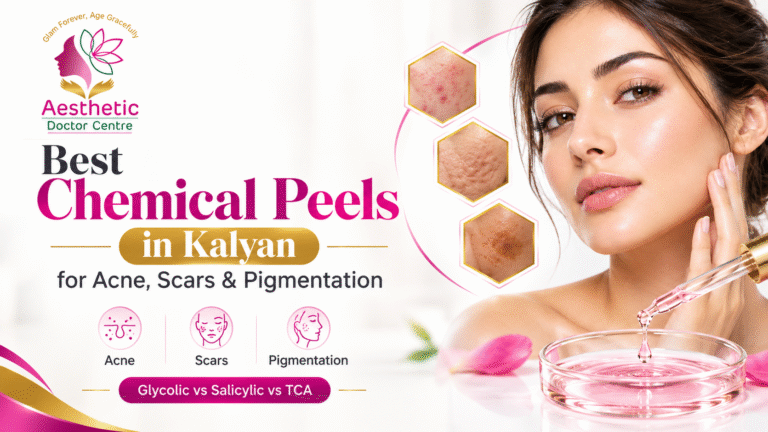
Chemical peels in Kalyan work by applying a controlled acid solution to the skin to remove damaged outer layers and trigger fresh cell turnover, and the right type for you depends entirely on whether you’re treating active acne, old scars, or pigmentation. There’s no single “best” peel for everyone glycolic, salicylic, and TCA peels each target different concerns at different depths, and choosing the wrong one wastes both money and downtime.
This guide breaks down the actual differences between peel types, what results to realistically expect, and how to decide which one fits your skin.
A chemical peel is a controlled application of an acid solution that causes the outer, damaged layer of skin to shed, encouraging new, smoother skin to form underneath. Peels are classified by how deep they penetrate superficial, medium, or deep and depth is what determines both the results and the recovery time. Superficial peels work within the epidermis and involve minimal downtime, while medium and deep peels reach further into the skin to address more stubborn scarring and pigmentation, at the cost of longer recovery.
Best chemical peels use carefully selected acid solutions to remove damaged outer skin cells and encourage smoother, fresher skin. Depending on your skin concerns, chemical peels can help improve acne, scars, pigmentation, and uneven skin tone.
This is one of the most common questions people ask before booking a peel, and the two work quite differently at a chemical level.
Glycolic acid is an alpha-hydroxy acid (AHA) that is water-soluble and works primarily on the skin’s surface, dissolving the bonds between dead skin cells to boost turnover, brighten tone, and fade superficial pigmentation. It suits most skin types and general dullness. Salicylic acid, by contrast, is a beta-hydroxy acid (BHA) that is oil-soluble, meaning it can penetrate into pores to dissolve sebum buildup and calm inflammation which is why it’s usually the better choice for active acne and oily, congested skin rather than pigmentation alone.
Glycolic acid peels and salicylic acid peels are two of the best chemical peels for different skin concerns. Glycolic acid peels help improve skin texture, brighten uneven skin tone, and reduce superficial pigmentation, while salicylic acid peels penetrate pores to remove excess oil and help manage active acne and congested skin. The best chemical peel for your skin depends on your skin type, concerns, and a professional assessment.
The right peel depends on how deep the scarring actually is, not just how visible it looks in the mirror.
Fact: Glycolic acid peels suit mild scarring and dark spots with minimal downtime of roughly 1 to 3 days, while TCA (trichloroacetic acid) peels are better suited to moderate to severe scarring but require 7 to 14 days of recovery. Salicylic acid peels work well for oily, acne-prone skin and active breakouts but are generally less effective on deeper scar texture.
For genuinely deep or atrophic (pitted) scarring, peels are often combined with other treatments like microneedling, and a practitioner should assess scar depth in person before recommending a protocol.
Pigmentation, whether from sun exposure, hormones, or post-acne marks, responds differently depending on how deep the discoloration sits in the skin.
A published clinical report notes that a series of glycolic acid peels can reduce pigmentation by roughly 35–60% over a six-session protocol, with standard sessions spaced 2–4 weeks apart depending on pigment depth and skin response. For pigmentation linked to active acne, a salicylic acid–based approach is often layered in, since it addresses both the discoloration and the inflammation feeding it.
Peel Depth | Common Agents | Typical Downtime | Best For |
Very superficial | Low-strength glycolic, salicylic, retinoic acid | Little to none | Mild dullness, maintenance, minimal pigment |
Superficial | 30–50% glycolic acid, Jessner solution, salicylic acid | 1–5 days | Mild acne, uneven tone, early pigmentation |
Medium | 35% TCA combined with glycolic or Jessner solution | 5–10 days | Moderate acne scarring, deeper pigmentation |
Deep | TCA over 50%, phenol/croton oil combinations | 7–14+ days | Severe scarring, significant photodamage |
Deep peels require close medical supervision and are typically performed only by experienced practitioners, given the higher risk of complications at that depth.
This varies by concern and peel type, and no honest clinic can promise a fixed number without assessing your skin first.
Fact: Superficial peels for mild concerns are often done in a series of 4 to 6 sessions spaced roughly 2 to 4 weeks apart, since results are cumulative and each session builds on the last. Medium-depth peels for moderate acne and scarring may be done in fewer sessions sometimes as few as two, spaced about four weeks apart because each treatment penetrates deeper. Deep peels are typically a one-time or infrequent procedure due to the extended recovery involved.
Recovery expectations are one of the areas where marketing language and clinical reality diverge the most.
Regardless of peel depth, daily sunscreen is non-negotiable during recovery — new skin is significantly more vulnerable to sun damage and pigmentation rebound.
Not automatically, and this is where a proper consultation matters more than the peel type itself. Deeper peels and certain high-strength formulations carry a higher risk of post-inflammatory pigmentation changes in darker skin tones if not selected and monitored carefully. This doesn’t mean darker skin can’t be treated it means the concentration, type, and depth of peel need to be chosen deliberately rather than applied as a standard package.
How much does a chemical peel cost in Kalyan? Cost varies by peel depth, the acid used, and the number of sessions required. Superficial peels are generally more affordable per session than medium or deep peels, though deep peels may need only one treatment. A consultation will give you an accurate, personalized estimate.
Is a chemical peel better than a laser for pigmentation? Neither is universally “better” peels and lasers work differently and suit different pigment depths and skin types. A practitioner can assess your specific pigmentation pattern to recommend the more suitable option.
Can I get a chemical peel if I have active acne breakouts? Yes, in many cases. Salicylic acid peels in particular are often used specifically for active acne because of their oil-soluble, anti-inflammatory action, though your practitioner will confirm suitability based on how active and severe the breakout is.
Do chemical peels work for open pores? Superficial and medium peels can improve the appearance of pores over a series of sessions by improving overall skin texture, though they don’t physically shrink pore size permanently.
How long before I see results? Superficial peels often show visible improvement in skin tone and texture within a few sessions, while deeper concerns like scarring or stubborn pigmentation typically take a full series to show meaningful change.
Are chemical peels suitable for men? Yes. Peel selection is based on skin type and concern, not gender, so men with acne, scarring, or pigmentation can follow the same assessment process.
The difference between a peel that works and one that disappoints usually comes down to matching the acid, strength, and depth to your actual skin concern not picking whichever option sounds the most advanced. If you’re in Kalyan and unsure whether glycolic, salicylic, or a medium-depth peel suits your skin, an in-person assessment will give you a far more reliable answer than any generic guide.
Dr. Jyoti Ghindani, MS Ophthalmology and Fellow in Aesthetic Medicine & Trichology, specialises in facial procedures, pigmentation correction, and anti-aging therapies, bringing surgical precision to skin treatment planning. You can book a chemical peel consultation or explore our full range of skin treatments to find the right protocol for your skin type.
For further reading on peel classification and clinical evidence, see the NCBI StatPearls overview of chemical peels for skin resurfacing and peer-reviewed studies available via PubMed/NCBI.
Book your Appointment